
LONG MARCH TO FREEDOM:
A 350-YEAR JOURNEY TO LIBERATION (1652-1994)
Towards a New Democracy
On 11 February 1990 Nelson Mandela walked free after 27 years imprisonment. From the balcony of the Cape Town
City Hall, he repeated his words from the 1964 Rivonia Trial when he was sentenced to life imprisonment: ‘I have
fought against white domination, and I have fought against black domination. I have cherished the idea of a
democratic and free society in which all persons live together in harmony and with equal opportunities. It is
an ideal which I hope to live for and to achieve. But if needs be, it is an ideal for which I am prepared to die.’
In the period that followed, mass meetings and mobilisations, strikes, protests, demonstrations and violence ushered
in profound uncertainty and potentially dangerous instability in the country.
The ANC, National Party Government and other political organisations committed to resolving the violence and
intimidation, and removing obstacles to negotiations. In 1991 the National Peace Accord was signed, paving the
way for the Convention for a Democratic South Africa – CODESA – which commenced in December of that year. In a
1992 whites-only referendum indicated that more than two-thirds of white voters favoured the negotiations for a
democratic constitution, but talks broke down later that year over the primary concerns of majority rule and power
sharing. Mass action campaigns and violence soon erupted. At Boipatong in the Vaal Triangle 45 people were massacred
in a factional attack, and at Bisho in the Ciskei homeland (now Eastern Cape) 28 ANC supporters were gunned down by
the Ciskei defence force. Behind-the-scenes meetings later in 1992 between government representative Roelf Meyer and
the ANC’s Cyril Ramaphosa managed to get negotiations back on track, leading to the Multi-Party Negotiating Forum
(MPNF) in April 1993, which included greater participation from parties on the extreme right and left of the political spectrum.
Proceedings at the MPNF did not run smoothly. The mainly Zulu Inkatha Freedom Party (IFP), claiming they were being
side-lined, pulled out and formed the Concerned South Africans Group together with traditional leaders, homeland
leaders, and white right-wing groups. A period of brinkmanship followed, with the IFP remaining out of the negotiations
until within days of the election in 1994.
On 10 April 1993 the assassination by white right-wingers of Communist Party and ANC leader, Chris Hani, brought the
country again to the brink of disaster. Nelson Mandela appealed to black and white South Africans to stand together
against “the men who worship war” and to “move forward to what is the only lasting solution for our country – an
elected government of the people, by the people and for the people”. It would prove a turning point, after which
the main parties pushed for a settlement with increased determination. The MPNF ratified the interim Constitution
in the early hours of the morning of 18 November 1993.
On 27 April 1994 millions of South Africans of all races stood together peacefully for hours in kilometre-long
queues to make their mark at the polls. For most it was the first time that they or any of their forbears had
been able to vote or indeed have any say on how their country should be governed. The ANC won 62% of the vote
and on 10 May 1994 Nelson Mandela was sworn in a South Africa’s first democratically elected president. Under
the Government of National Unity (GNU), South Africa was divided into today’s nine provinces, replacing the four
pre-existing provinces and 10 black homelands. The GNU additionally oversaw the drafting of a new constitution
which came into effect in 1997, and is still regarded as one of the most progressive in the world today.
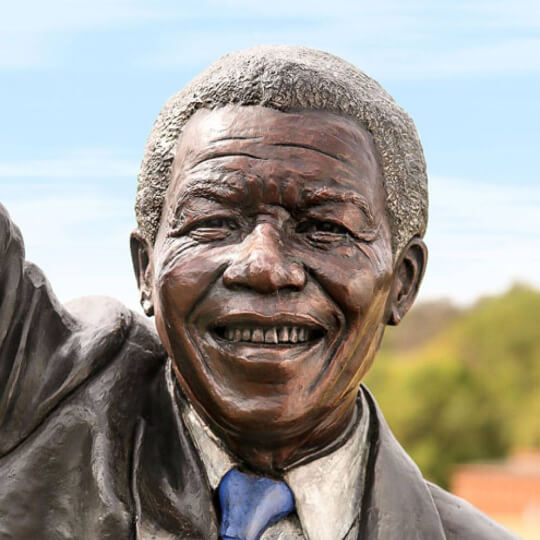
Nelson Mandela (1918 - 2013)
South Africa's first democratically elected President, President of the ANC and Nobel Peace Prize winner
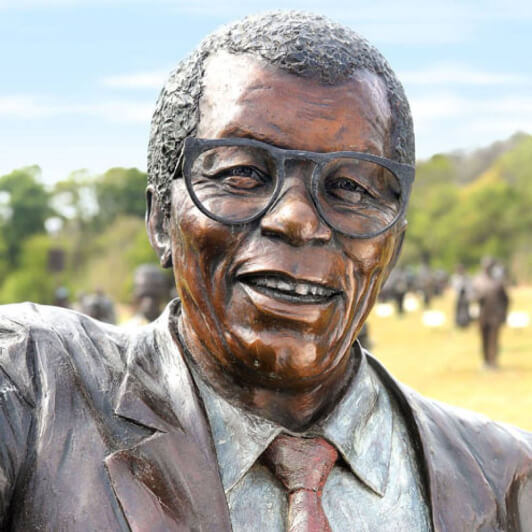
Oliver Reginald Tambo (1917 - 1993)
Longest-serving President of the ANC, and leader of the organisation in exile
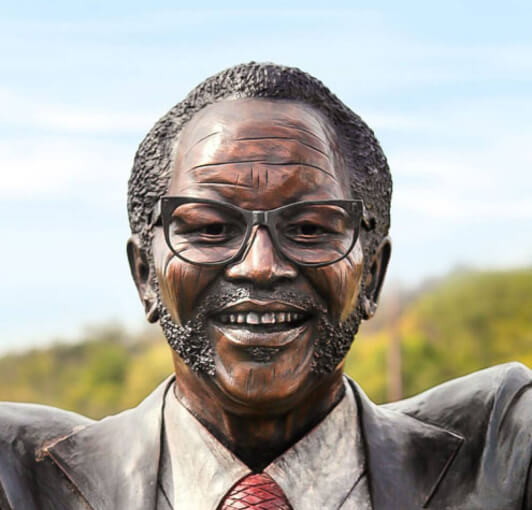
Walter Ulyate Max Sisulu (1912 - 2003)
Anti-apartheid activist and political leader, Rivonia Trialist and Robben Island prisoner

BROUGHT TO YOU BY THE
NATIONAL HERITAGE PROJECT NON-PROFIT COMPANY
NATIONAL HERITAGE PROJECT NON-PROFIT COMPANY